
Standard Greeting Card Size: Finished, Open & Envelope
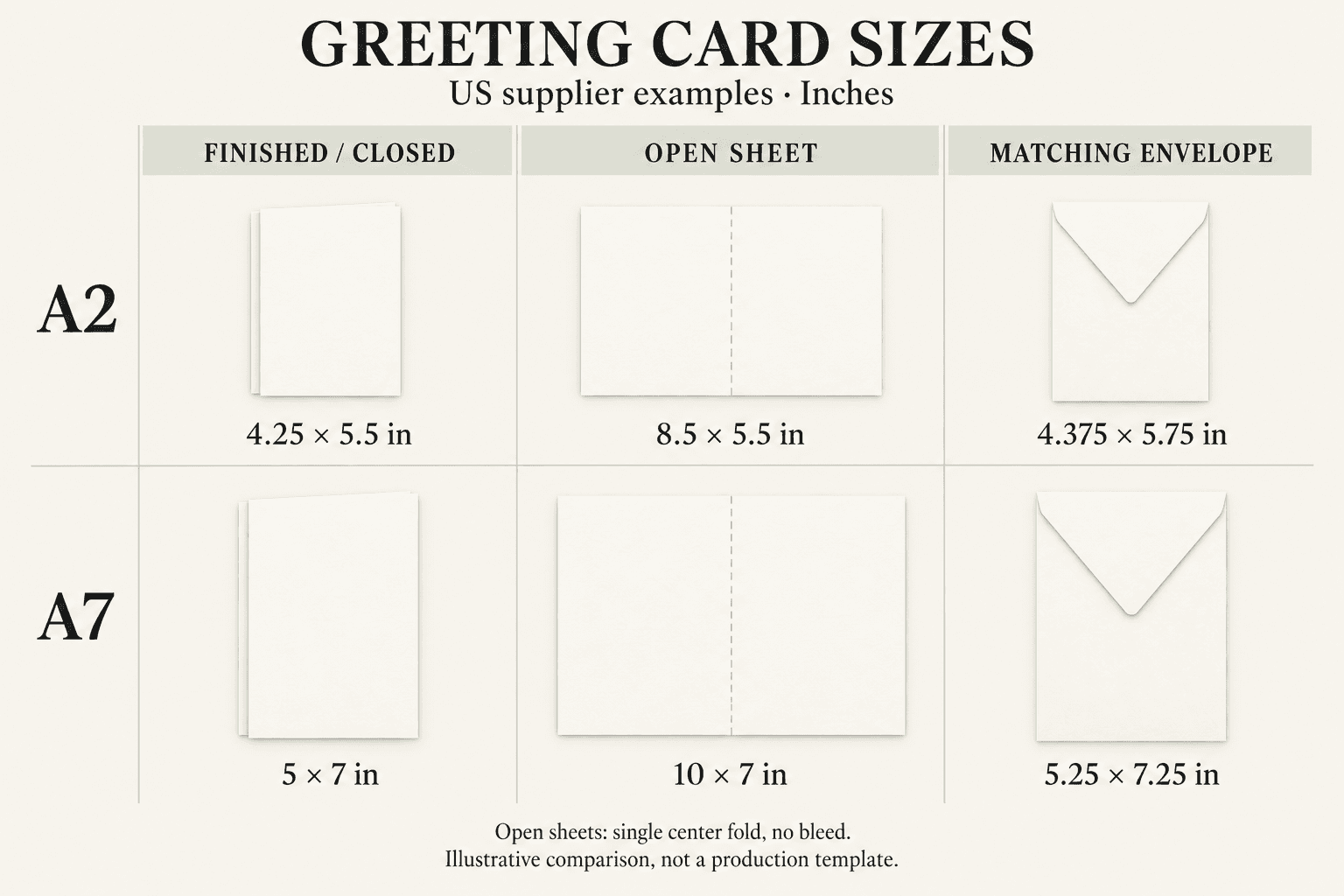
No single greeting card size works for every printer, occasion, or country. Two common US supplier examples are A2 at 4.25 × 5.5 inches finished and A7 at 5 × 7 inches finished. A simple side-fold A2 example opens to 8.5 × 5.5 inches; a side-fold A7 example opens to 10 × 7 inches.
The finished card, open sheet, envelope, and artwork file are different measurements. Confirm all four with the selected printer before preparing final files.
Reviewed
Greeting card dimensions at a glance
The table uses verified US supplier examples rather than ISO paper sizes. Its open dimensions assume one center fold without bleed.
| US supplier label | Finished or closed card | Open sheet example | Matching envelope example |
|---|---|---|---|
| A2 | 4.25 × 5.5 in | 8.5 × 5.5 in | A2: 4.375 × 5.75 in |
| A7 / 5 × 7 | 5 × 7 in | 10 × 7 in | A7: 5.25 × 7.25 in |
For someone looking for a standard greeting card size in cm, the finished A2 example is 10.795 × 13.97 cm. The A7 example is 12.7 × 17.78 cm. Both use 1 inch = 2.54 cm. These are unit conversions, not ISO A-series sizes or proof that MARKFOLDS can enter decimal millimeters exactly.
These verified sizes include an A2 finished card that measures 4.25 × 5.5 inches and an A7 finished card at 5 × 7 inches. Red River lists the finished and open card sizes. PrintPlace and Altenew publish the matching envelope examples. Treat them as common US standard sizes, not one rule for every product.
Read four measurements before choosing a size
People asking what size a greeting card is often see one number without a label. That can produce the wrong canvas or envelope. Read the specification in this order:
- Finished or closed size — what the recipient holds after a folded card is closed.
- Open sheet size — the full paper before the center fold.
- Envelope size — the inside fit must allow the card to enter and leave without damage.
- Artwork file size — the printer may require extra area for bleed, marks, or another production setup.
Do not assume the largest dimensions are always the finished card. PrintPlace, for example, describes a 10 × 7-inch open card that folds to 5 × 7 inches. A listing that says only “10 × 7” needs its label and template checked.
How finished and open sizes relate
For a simple single-center fold, one open dimension is twice the corresponding finished dimension. A 5 × 7-inch side-fold card can use a 10 × 7-inch open sheet. The fold direction determines which side doubles.
This is a geometry check, not proof that a printer offers every possible format. It also does not include bleed. Use the actual product template for the fold line, panels, safety areas, and delivery file.
Flat greeting cards are simpler because the finished card and the physical sheet use the same trim dimensions. They can still need a larger artwork canvas when the printer asks for bleed.
Why A-labels can be confusing
US card and envelope suppliers use labels such as A2, A6, and A7. ISO paper standards also use A-labels. The names do not guarantee the same dimensions.
Even within one supplier page, labels may be inconsistent. Red River's A6 product content lists a 4.5 × 6.25-inch finished example, while its FAQ gives 4.625 × 6.25 inches. That conflict is a reason to check the numeric trim size, not a reason to declare either value universal.
If a printer says “A6,” ask for the finished width and height, open sheet dimensions, fold direction, and matching envelope. Use those numbers in the production template.
Match the envelope to the finished card
When comparing greeting card sizes and envelopes, choose an envelope slightly larger than the finished card. This lets you insert and remove the card without using the open sheet as the fit measurement.
For the examples above, a 4.25 × 5.5-inch A2 card pairs with a 4.375 × 5.75-inch A2 envelope. A 5 × 7-inch card pairs with a 5.25 × 7.25-inch A7 envelope. Suppliers publish these pairings for their products; do not treat them as universal clearances. Labels such as standard envelopes still require exact dimension checks.
Paper thickness, layered photos, inserts, embellishments, rounded corners, and unusual folds can change the fit. Cut a paper sample at 100% scale. Put the real contents inside, close the envelope, and remove the card again before ordering a batch.
Envelope fit does not establish postage. Postal price, shape, thickness, stiffness, and destination rules require a separate current check with the relevant carrier.
Choose a format from the message and use
Smaller cards leave less room for long copy. A7 cards give a photo, larger type, or longer greeting more space. For a custom greeting card, choose finished dimensions supported by the selected printer rather than relying on an average greeting card size.
For an ecommerce parcel, measure the completed pack-out before choosing the card. A flat card may fit more reliably than a folded card with an envelope. For a mailed personal greeting, check the closed card, envelope, and current mailing rules together.
If the job is a thank-you insert, use the thank-you card size guide. For a wallet gift card or separate carrier, use the gift card size guide. Business-card trim and pixel calculations belong in the business card size guide.
Plan greeting card artwork in MARKFOLDS
Open the MARKFOLDS Generator. Choose Holiday greeting card for a supported seasonal direction. Choose Others for another clearly described card purpose. Start with approved copy, a finished format, and one visual direction.
MARKFOLDS creates coordinated Front and Back digital artwork for review. It supports PNG delivery. SVG delivery depends on the current plan, saved artifact state, and vector-safety path. Check Product Facts and Pricing before relying on a specific export.
The custom-size input accepts 30–600 mm per side and normalizes values to whole millimeters. US fractional-inch conversions often produce decimal millimeters. The input cannot represent every supplier size exactly. A rounded canvas can support visual planning; it is not the printer's production template.
MARKFOLDS does not create a complete four-face folded-card layout. It does not automatically add fold lines, imposition, bleed, crop marks, CMYK conversion, font outlining, PDF/X conformance, or a matching envelope. It does not print, mail, or certify artwork as press-ready.
If the design uses a QR code, provide a stable URL and label the destination. MARKFOLDS supports a static supplied URL. It does not provide dynamic destination management or scan tracking. Test the printed proof at final size.
Greeting card size checklist
- Identify the exact printer and card product.
- Record the finished or closed width and height.
- Record the open sheet size and fold direction.
- Record the matching envelope's stated dimensions.
- Download the printer's current artwork template.
- Keep text, logos, and codes within its safe area.
- Use its required file, color, and bleed settings.
- Test a full-size paper sample with the real envelope.
- Review every panel and approve a physical or printer proof.
Frequently asked questions
What is a standard greeting card size?
No single size covers every greeting card. Common US supplier examples include A2 at 4.25 × 5.5 inches finished and A7 at 5 × 7 inches finished. Confirm the numeric dimensions and template for the exact printer and product.
Are greeting card measurements folded or open?
They can mean either. A folded-card listing may show the finished closed card, the open sheet, or both. Label each measurement. A simple side-fold 5 × 7-inch card can open to 10 × 7 inches before bleed.
What envelope fits my greeting card?
Match the envelope to the finished card and follow the supplier's pairing. Published examples include a 4.375 × 5.75-inch A2 envelope for a 4.25 × 5.5-inch card, and a 5.25 × 7.25-inch A7 envelope for a 5 × 7-inch card. Test thick or layered cards physically.
Can MARKFOLDS export a complete folded-card print layout?
No. MARKFOLDS creates coordinated Front and Back digital artwork, not an automatic four-face folded-card production file. Prepare the final fold, panel, bleed, color, and printer requirements in the selected provider's current template.