
Personal birthday card guide / Reviewed October 9, 2026
Birthday Card for Wife: Words That Feel Like You
A birthday card for your wife can celebrate who she is, as well as your life together. Start with one thing you admire. Add a small, true detail from this year. Finish with a wish that suits her. Those three choices give a short message a clear purpose.
You do not need a perfect phrase or a long account of your marriage. A few words can feel personal when they reflect something she values. The aim is to help her feel seen on her birthday.
This guide takes you from rough notes to a short greeting and one clear artwork brief. The examples are original writing ideas. Use only the details that fit your own relationship. MARKFOLDS can help create digital card artwork; you still choose the words and check the finished file.
Make her birthday about her
Begin with her interests, qualities or hopes. Think about what she enjoys when she has time to herself. She may like a quiet walk, a favourite book or a busy day with friends. Choose something you know about her now.
It helps to separate who she is from what she does for other people. “You keep us all organised” may praise a useful job. “I love your curiosity” celebrates a quality. Either thought can come from real affection, but the second gives her birthday more room.
A card can recognise kindness without making her responsible for everyone’s happiness. For example, thank her for a small act you noticed. Avoid turning the message into a list of household work. Read it once as if she were receiving praise for herself.
Keep your usual way of speaking. If you rarely use grand romantic language, a plain sentence can feel warmer. Choose a quality you have seen. Do not invent an age, an achievement or a shared memory to make the writing sound more specific.
Match the wish to the birthday she wants
Before writing “Have the best day ever,” consider what a good day means to her. A big celebration may delight one person and tire another. The card should support her preference, even when your own ideal birthday looks different.
Use what she has said about this birthday. She may want time outdoors, a meal with a few people or an ordinary evening with no extra plans. If you are unsure, ask a simple question about the day. Let her answer guide the wish.
Keep plans and promises separate. “I hope today brings you time for the things you enjoy” expresses a wish. “I’ve booked your favourite restaurant” describes a plan. Write the second only when the booking exists and she will welcome it.
The same care applies to the coming year. Support an interest she has chosen. Avoid giving her a new goal in the card. A wish for more time to read is useful only if she wants that time. Her birthday is a chance to celebrate her choices.
Check how she feels about an age or a large birthday event. She may enjoy a number on the card, or prefer a simple greeting. Ask if you are unsure. Leave the age out unless you know she wants it there and you have it right.
If she wants a quiet day, let the words reflect that. “Wishing you a peaceful birthday and time for the things you enjoy” can stand on its own. You can add your name and a short personal line. The message can still show care without describing a big celebration.
Build one thought in three parts
Write three rough notes before you look at artwork. Use everyday words. These notes help you choose a message; they do not all need to appear on the card.
- Appreciation: Name one quality you admire about her.
- A true detail: Recall one small moment from this year that shows it.
- A birthday wish: Decide what you hope the day or next year will hold for her.
For appreciation, choose a word you could explain. Curiosity, courage or a sense of fun can work when you have seen it. A broad word such as “wonderful” gives you less to build on. Ask yourself what made you choose it.
For the detail, think about a recent moment rather than searching for your most important memory. Perhaps she noticed a flower during a walk, asked a thoughtful question or tried something new. These are prompts for your notes, not facts about your wife.
For the wish, look forward. What would she welcome more of? Choose one thought, such as time for an interest or small discoveries. You now have a link between a quality, a real moment and her future.
Choose a detail she will recognise
Read the moment you wrote down. Would she know what you mean without a long explanation? If the answer is no, choose a clearer detail or leave it out. The point is recognition, not proof that you remember every event.
Keep the detail small enough for the message. You might write “I love the way you notice a new flower on our walks.” You do not need the date, the route or every part of the conversation. Use this line only if those walks are part of your life.
Think about who else may see the artwork. A card could sit on a shelf, appear in a photo or pass through a printer’s hands. Leave out private health details, money worries and personal information she has not chosen to share.
If this has been a difficult year, you can still name something you value. You do not need to turn a struggle into a lesson or claim that everything is fine. A simple birthday wish can stand on its own. Keep any longer, private message separate from the artwork.
Turn the notes into a birthday message
Here is one editing example. It shows how to choose a thought rather than add more praise.
A first draft might read: “You are curious, clever, kind and wonderful, and I hope you have the best birthday ever.” The feeling is warm, but the sentence lists several qualities. It gives each one little space.
Choose curiosity as the main thought. If a recent walk really fits, your notes might be: “She notices things I miss. We found a flower on a walk. I hope she has more discoveries this year.” Keep those rough notes outside the final artwork.
A shorter message could be: “Happy birthday, my love. I love how you spot the small wonders I walk past. Here’s to more discoveries this year.” It marks the birthday, names a quality and looks ahead. It does not need a list of memories.
Now read it aloud. If “small wonders” sounds unlike you, use words you would say. Try “I love the things you notice on our walks.” If the last line feels too broad, make the wish about her day. Edit the thought until it fits your voice.
That longer message may belong in a separate note. For a short card greeting, keep the part you value most: “Happy birthday. I love your curious heart.” You can preserve the meaning even when the artwork needs fewer words.
Give the last line a job
The final wish should add something. Read it after the appreciation line. Does it point towards her birthday, or repeat the same praise?
Suppose your draft ends with “You are amazing and deserve an amazing day.” The repeated word makes the wish vague. You could choose “I hope today gives you time for what you love.” This line leaves room for her own idea of a good birthday.
Use a future wish when it fits the note. “Here’s to more discoveries this year” connects with curiosity. A wish for rest would need a different reason. Choose the connection first, then the wording. You do not need to cover every hope in one card.
Check that the sentence asks nothing of her. Avoid slipping a request into the birthday message. Save discussions about plans, chores or changes for another time. End with a clear wish and your name.
Make one final personal check
Put the draft beside your three rough notes. First, underline the words that describe her quality. Next, circle the detail she will recognise. Finally, find the birthday wish. Each part should have a clear role, even if you keep only two parts in the short artwork.
Ask whether another person’s name would fit the message just as easily. If it would, look again at your true detail. One small change may make the thought more personal. You do not need to add more praise or make the sentence longer.
Check the note against what she wants this year. You may love a memory from years ago, but a recent detail can show that you notice her now. Keep an older memory if it matters to her; let it support the birthday thought.
Save the chosen wording in one place before you start the design. Mark which line belongs on the artwork and which words belong in the separate note. This makes the next step easier and gives you a clear reference when you review the output.
Decide what belongs on the artwork
Birthday cards can hold a short greeting while a separate note carries the longer thought. Decide which part you want her to see first. That choice helps you avoid shrinking a whole letter into a small space.
Keep a short line for the main greeting. Put the detail and longer wish in a handwritten note if you want to preserve them. You can also arrange longer copy in another layout tool. Check the printed or shared result yourself.
For MARKFOLDS, the Slogan limit is 80 characters. Count spaces and punctuation as part of your short line. “Happy birthday, my love.” has 24 characters, including its spaces and full stop. It leaves plenty of room within that limit.
A short input does not ensure the tool will include every word or place it exactly where you expect. The chosen format may leave the Slogan out. Keep your approved wording in your own notes so you can compare it with the artwork.
Give the birthday wish room
Plan one clear Front and Back arrangement. Use the Front for the birthday greeting and one small motif. Use the Back for a brief second line and your name. Leave space around the words so they remain easy to read.
Choose a motif that connects with your thought. A favourite flower can suit a message about noticing small things. It does not need to show the whole memory. Repeat a small part of the motif on the Back to link the artwork.
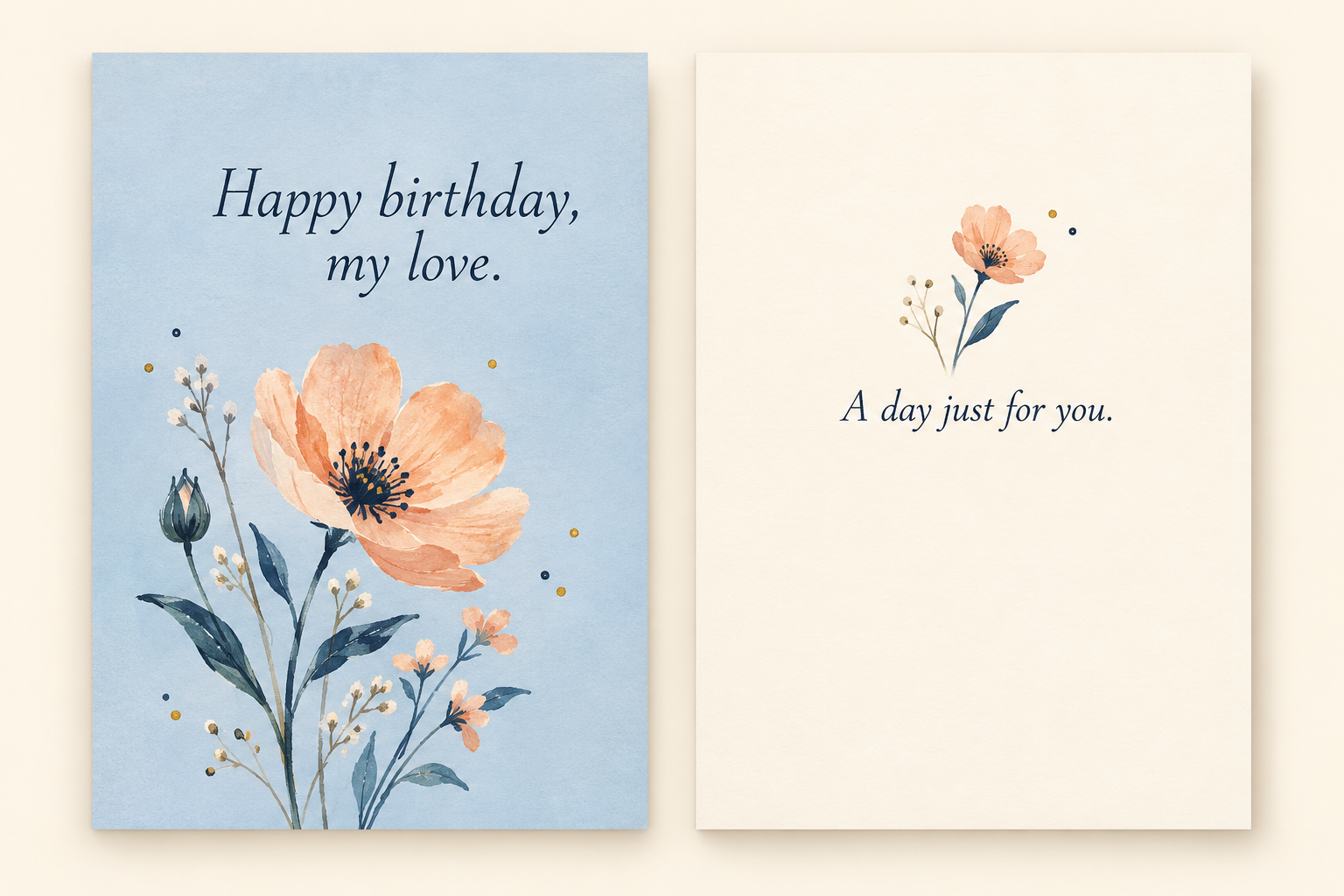
In this concept, the Front says “Happy birthday, my love.” The Back says “A day just for you.” Those lines show a simple order: first the greeting, then the birthday wish. Use your own wording if either line feels unlike you.
Front and Back are separate artwork surfaces. They do not create an automatic folded-card cover and inside layout. Check the greeting card size guide when you plan a physical card. For broader romantic motifs, see the Valentine design guide.
Choose between a bought card and digital artwork
Choose a bought card when you want a finished physical item and find one you like. Check the seller’s own details for paper, personalisation and delivery. Those services belong to the seller.
Create digital artwork when you want to choose the message and visual direction yourself. That route gives you a design step to review. You still need to decide how to share the file or arrange physical printing.
MARKFOLDS supports the digital artwork step. It does not sell or post finished birthday cards. If the delivery date matters, check your printer or seller’s timing before choosing a route. A good message can work with either choice.
Make the artwork with MARKFOLDS
Sign in to MARKFOLDS and enter the required Brand or project name. Choose Others for this card purpose. The tool has no dedicated wife-birthday preset or ready-made birthday template gallery.
Write a short description of the purpose. For example: “Birthday card for my wife; a small flower motif, cream and blue, clear space for a short greeting.” This describes the artwork you want. It does not ask the tool to invent a relationship or a personal memory.
Put your approved short line in Slogan. The field is optional. Stay within its 80-character limit and check whether the output includes it. Keep a longer letter outside that field.
Review both artwork surfaces before you confirm the saved design. Compare the greeting with your approved text. Check spelling, the name, colour contrast and the space around the words. A pleasing picture still needs this review.
If the wording changes or disappears, do not assume the file now carries your message. Keep your separate note, or prepare the exact text in another layout tool. The first-card workflow explains the current controls and review steps.
Check the actual file before giving the card
Download the artwork and view the real file at the size you plan to use. Read the small text as well as the main greeting. Check that the name and sender are correct. Look for anything you did not intend to include.
PNG is available. SVG delivery depends on the current plan and saved artwork; not every visual stays editable vector artwork. See Product Facts for current limits. Choose from the export options the tool shows for your saved design.
If you plan to print it, ask your printer to approve that exact file and the layout. A file extension alone does not settle paper size, fold placement or print quality. MARKFOLDS does not print or post cards. Keep the file you approved separate from earlier attempts so you hand over the right version.
Frequently asked questions
What should I write in a birthday card for my wife?
Start with one quality you admire. Add a true detail from this year if it fits a short message, then a wish for her day or next year. Read it aloud and choose words you would say. “Happy birthday. I love your curious heart” is an original short example. Use it only if it suits her; keep a longer explanation in a separate note.
Should I buy a card or create my own artwork?
Buy a card when you want a finished physical item. Check that seller’s paper, personalisation and delivery details. Create digital artwork when you want to plan your own words and visual direction. MARKFOLDS supports that artwork step. It does not supply printed cards or delivery, so arrange those parts separately and check the timing if you need a physical card for a set date.
Can MARKFOLDS fit a long birthday letter on the card?
Slogan has an 80-character limit. The chosen format may leave it out, and the tool does not ensure exact wording or placement. Choose one short greeting and check the actual artwork. Write a longer letter by hand or arrange it in another layout tool. That keeps your full thought separate from the short artwork message.
Open the MARKFOLDS card generator when you have chosen one true thought and a short birthday greeting.